History of the National Industrial Court of Nigeria
Explore the rich history of the National Industrial Court of Nigeria and its journey from inception to present day, as a key judicial institution for labor and employment disputes.

History of the National Industrial Court of Nigeria hero image
History of the National Industrial Court of Nigeria
Explore the rich history of the National Industrial Court of Nigeria and its journey from inception to present day, as a key judicial institution for labor and employment disputes.
Early Establishment
Establishment and Early Years
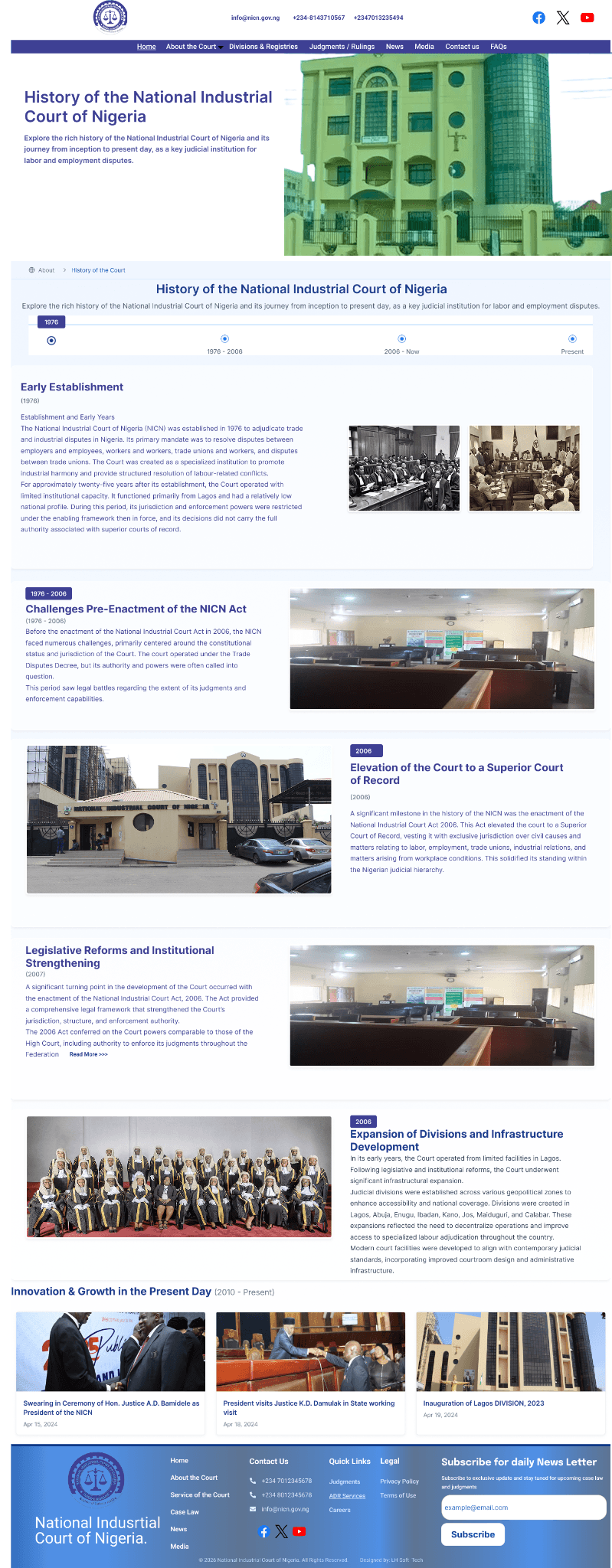
The National Industrial Court of Nigeria (NICN) was established in 1976 to adjudicate trade and industrial disputes in Nigeria. Its primary mandate was to resolve disputes between employers and employees, workers and workers, trade unions and workers, and disputes between trade unions. The Court was created as a specialised institution to promote industrial harmony and provide structured resolution of labour-related conflicts.
For approximately twenty-five years after its establishment, the Court operated with limited institutional capacity. It functioned primarily from Lagos and had a relatively low national profile. During this period, its jurisdiction and enforcement powers were restricted under the enabling framework then in force, and its decisions did not carry the full authority associated with superior courts of record.
Challenges Pre-Enactment of the NICN Act
Before the enactment of the National Industrial Court Act in 2006, the NICN faced numerous challenges, primarily centered around the constitutional status and jurisdiction of the Court. The court operated under the Trade Disputes Decree, but its authority and powers were often called into question.
This period saw legal battles regarding the extent of its judgments and enforcement capabilities.

Elevation of the Court to a Superior Court of Record
A significant milestone in the history of the NICN was the enactment of the National Industrial Court Act 2006. This Act elevated the court to a Superior Court of Record, vesting it with exclusive jurisdiction over civil causes and matters relating to labor, employment, trade unions, industrial relations, and matters arising from workplace conditions. This solidified its standing within the Nigerian judicial hierarchy.
Legislative Reforms and Institutional Strengthening
A significant turning point in the development of the Court occurred with the enactment of the National Industrial Court Act, 2006. The Act provided a comprehensive legal framework that strengthened the Court's jurisdiction, structure, and enforcement authority.
The 2006 Act conferred on the Court powers comparable to those of the High Court, including authority to enforce its judgments throughout the Federation. Read More ›››
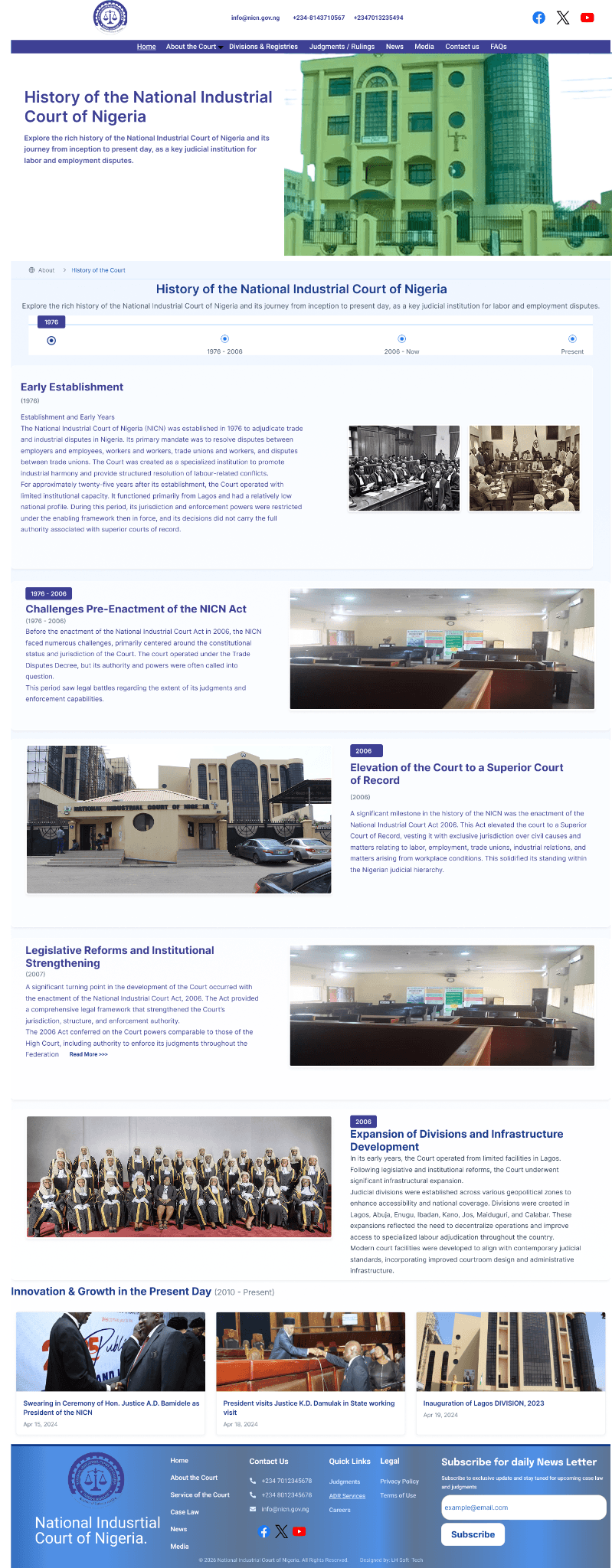

Expansion of Divisions and Infrastructure Development
In its early years, the Court operated from limited facilities in Lagos. Following legislative and institutional reforms, the Court underwent significant infrastructural expansion.
Judicial divisions were established across various geopolitical zones to enhance accessibility and national coverage. Divisions were created in Lagos, Abuja, Enugu, Ibadan, Kano, Jos, Maiduguri, and Calabar. These expansions reflected the need to decentralize operations and improve access to specialized labour adjudication throughout the country.
Modern court facilities were designed to align with contemporary judicial standards, incorporating improved courtroom design and administrative infrastructure.
Innovation & Growth in the Present Day (2010 - Present)